Anselm Kiefer
The Seven Heavenly Palaces 2004-2015
FROM 24 SEPTEMBER 2004
Permanent Installation


Admission to the exhibitions is free and online reservation guarantees priority access in the selected time slot to Anselm Kiefer’s permanent installation and to current temporary exhibitions. Members have priority access even without reservation.
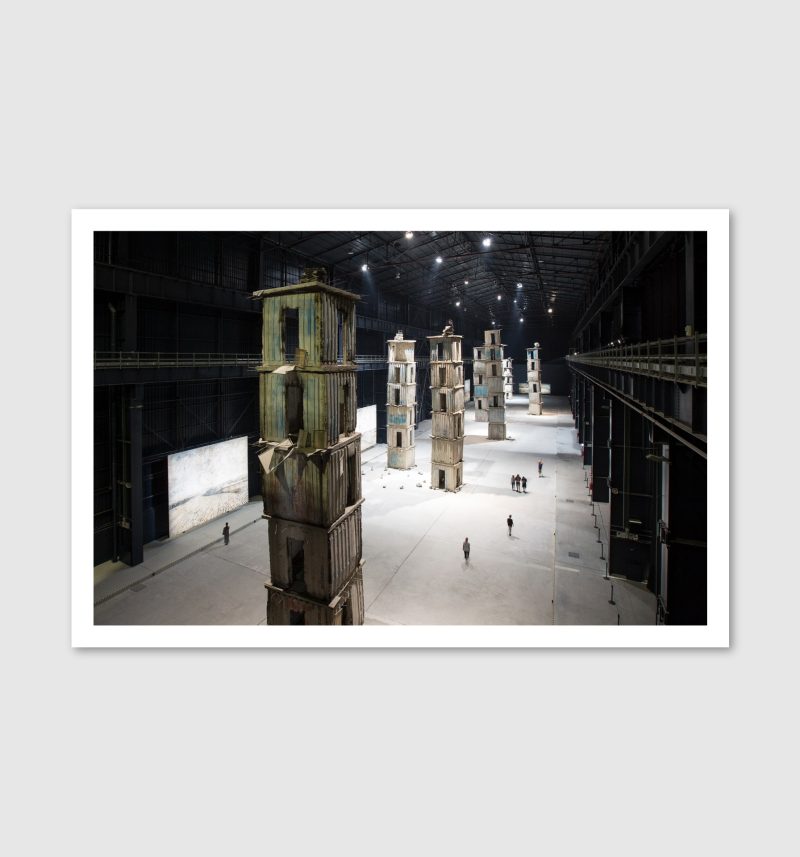
Conceived and presented for the opening of Pirelli HangarBicocca in 2004 and based on a project by Lia Rumma, the permanent site-specific installation by Anselm Kiefer—The Seven Heavenly Palaces—owns its name from the palaces described in the ancient Hebrew treatise Sefer Hechalot, the “Book of Palaces/Sanctuaries,” which dates back to the 5th-6th centuries A.D. The volume narrates the symbolic path of spiritual initiation that anyone who wants to become closer to God must undertake.
Works by Anselm Kiefer on display at Pirelli HangarBicocca in Milan
The seven towers—each of which weighs 90 tons and rises to heights varying between 13 and 19 meters—were created from reinforced concrete using the angular construction modules of shipping containers. The artist has inserted, between the various levels of each tower, lead books and wedges which, compressing beneath the weight of the concrete, further guarantee the static nature of the structure.
More than mere functional value, for Kiefer the use of this metal has symbolic meaning: in fact, lead is traditionally considered the material of melancholy.
The Seven Heavenly Palaces represents a point of arrival for Anselm Kiefer’s entire artistic production, synthesizing his principle themes and projecting them into a new timeless dimension: they contain an interpretation of ancient Hebrew religion; a representation of the ruins of Western Civilization after the Second World War; and projections into a possible future through which the artist invites us to face the present.
Since September 2015 five large canvases—produced between 2009 and 2013, and exhibited for the first time—enrich and expand the permanent installation. This additional display, curated by Vicente Todolí, reconsiders and confers new meaning on the artist’s work. The paintings—Jaipur (2009); two works of the series entitled Cette obscure clarté qui tombe des étoiles (2011); Alchemie (2012) and Die Deutsche Heilslinie (2012-2013)—are on show in the “Navate” space which hosts the permanent installation, giving new meaning to Anselm Kiefer’s masterpiece.
These paintings form, together with the “towers”, a single installation entitled The Seven Heavenly Palaces 2004-2015, which addresses themes already present in the site-specific work: large architectural constructions of the past as man’s attempt to ascend to the divine; constellations represented through astronomical numeration. They also add a number of considerations that are key to the artist’s poetic vision, including the relationship between man and nature, and references to the history of ideas and of Western philosophy.
Anselm Kiefer: the artist
Anselm Kiefer was born in Donaueschingen in Germany in 1945. He dedicated himself to art after studying law and literature. His first works, realized during the second half of the 1960s, were influenced by the gestures and artwork of Joseph Beuys.
Between 1993 and 2007, Kiefer moved to Barjac, in southern France, where he transformed a 350,000-square-metre silk factory into his home and studio. Today he works in Croissy and Paris, although many of his large installations are still housed in Barjac, forming a sort of personal museum and Gesamtkunstwerk (literally “total artwork”).


Anselm Kiefer: the most important works by the artist
Starting from the events that strongly marked Europe in the twentieth century, in his works Anselm Kiefer—one of the most relevant and influential contemporary artists—explores major concepts such as history, cultural identity, and the creation of myths.
Kiefer’s production during the 1970s was guided by a need to question Germany’s historical identity and mythology. He followed this line of inquiry by experimenting with different media including painting, photography, and an extensive production of artist books. In 1970 the Galerie am Kaiserplatz in Karlsruhe hosted his first solo exhibition, “Anselm Kiefer. Bilder und Bücher” [Anselm Kiefer. Paintings and books].
In 1971 Kiefer moved to Buchen, in the rural area of Walldürn-Hornbach, in the Odenwald forest, where he turned the attic of a former school building into a studio. The interiors of the Hornbach studio are depicted in a group of paintings known as the Attic series—including Resurrexit [He is risen] (1973) and Quaternität [Quaternity] (1973)—and were also chosen by the artist as the setting for works inspired by German sagas and Christian tradition.
In 1980 Kiefer and the painter and sculptor Georg Baselitz were invited as exponents of Neo-Expressionism to represent the German Federal Republic at the 39th Venice Biennale. The German pavilion featured Kiefer’s books and paintings made between 1970 and 1980. He subsequently traveled for the first time to Jerusalem to exhibit a solo show at the Israel Museum in 1984, previously hosted in Düsseldorf and Paris.
The trip to Israel was an important opportunity to study and research the Kabbalah, the set of Jewish mystical teachings. This cultural and symbolic imagery would accompany the artist’s oeuvre for the years to come.
Few years later, the artist participated in the group exhibition “Saturne en Europe” (1988) at the Musées de la Ville de Strasbourg, showing a series of works grouped under the title Saturn-Zeit [Saturn time] (1987): all the pieces except for one were made of lead. In the latter half of the 1980s the theme of Saturnine melancholy appeared in numerous works created with lead, including Saturn-Zeit, Schwarze Galle [Black bile] (1989), and Melancholia (1990–91).
The employment of lead and the idea of melancholy returned in another series of works that Kiefer presented in 1989 at the seminal group exhibition “Magiciens de la terre,” curated by Jean-Hubert Martin in Paris, that gathered works by over one hundred artists from all over the world with the aim of overcoming colonial ethnographic categorizations.
The use of lead brought an important change in the dimensions of Kiefer’s books, whose production increased during the years and which were enriched with subjects from Egyptian mythology and the Old Testament. By creating larger and larger books, he transformed them from objects to sculptures.
In 1988, Kiefer bought an abandoned 19th-century brickmaking factory: restored in order to create an “extension” of his studio in Buchen, the Höpfingen factory, in Baden-Württemberg, Germany, it was quickly transformed into a single large installation in which artworks and architecture complemented one another.
The following year, the artist produced a series created specifically for the spaces of the studio in Höpfingen: twenty-six sculptures titled Himmelspaläste [The heavenly palaces] on themes drawn from Jewish mysticism. A few years later, in 1992 he left Germany and moved to Occitania, in the south of France, settling in Barjac, in an abandoned industrial area of roughly 40 hectares called La Ribaute.
During the following three years, Kiefer took several trips through India, Thailand, Australia, Japan, and China. Following his experiences, he began to create large paintings introducing iconographic elements that represent ancient buildings and ruins emblematic of the places he visited: most of these are pyramids and brick structures, the shapes of which hark back to Sumerian ziggurats or Egyptian mastabas.
His work during these years also included desert landscapes, often characterized by thousands of sunflower seeds affixed to the surfaces of oil paintings.
Following his move to Barjac, Kiefer expanded his imagery by investigating the numbering of the cosmos: starting in 1995 he referred to the Romantic theme of starry skies in a series of paintings such as the wellknown Lichtzwang [Lightduress] (1999), dedicated to the poet Paul Celan (1920–1970).
Kiefer’s starry skies, in which he uses NASA alphanumerical sequences to map the constellations, are inspired by the nighttime skies of southern France and by the theories of Robert Fludd (1574–1637), a philosopher, astrologist, and alchemist who brought together Christian traditions, Kabbalah, and scientific knowledge to achieve a unique, all-encompassing vision of the universe.
Starting in the 2000s, the themes derived from Jewish mysticism took shape in environmental interventions, such as the series Chevirat Ha-Kelim [The breaking of the vessels], a project that Kiefer created at the Chapelle Saint-Louis de la Salpêtrière in Paris. In the same period, he shifted the mystical vision of the “spiritual journey” into a series of paintings inspired by late antique Hekhalot (literally “palaces”) literature, from which Kabbalists derived the notion of the soul’s ascension divided into seven cognitive levels, or seven Heavenly Palaces.
By adopting the building methods he already experimented with at La Ribaute, Kiefer’s imagery would materialize into a series of monumental, precarious “palaces” by assembling modules made of reinforced concrete. The same iconography would also recur in various projects in later periods: from the San Carlo theater in Naples, where he worked as set and costume designer for the 2003 performance of Elektra by Richard Strauss (1864–1949)— repeated in April 2017—to Sternenfall / Chute d’étoiles [Falling stars], presented in 2007 at the Grand Palais in Paris, and Jericho, an installation constituted by two seemingly unstable towers also installed in 2007 in the courtyard of the Royal Academy of Arts in London.
In 2009, for the celebration of the twentieth anniversary of the Opéra Bastille in Paris, Kiefer and the composer Jörg Widmann worked on the production of the opera Am Anfang [In the beginning], which premiered on July 7 of the same year. The artist revisited themes connected to the culture of the Kabbalah in 2011 for the exhibitions “Shevirat Ha-Kelim,” held at the Tel Aviv Museum of Art; “Anselm Kiefer. Sefer Hechalot” at the Museo de Bellas Artes in Bilbao; and “Anselm Kiefer. Salt of the Earth,” held inside the Magazzino del Sale, an exhibition space of Fondazione Emilio e Annabianca Vedova in Venice.
Other major exhibitions include a show held in 2013 in collaboration with the Hall Art Foundation at MASS MoCa in Massachusetts, as well as important retrospectives at the Royal Academy of Arts in London in 2014, and at the Centre Georges Pompidou in Paris in 2015. In 2017, the Musée Rodin in Paris inaugurated the exhibition “Kiefer Rodin,” which presented artworks inspired by Auguste Rodin’s (1840–1917) oeuvre.
Among recent exhibitions, in 2019 Kiefer has presented his works at the Couvent Sainte-Marie de La Tourette, a priory designed by Le Corbusier and located outside Lyon, France, which Kiefer had visited as a student. In 2020, the Kunsthalle Mannheim hosted a solo show by the artist, and the same year Kiefer’s permanent installation commissioned by the President of the French Republic was inaugurated at the Panthéon in Paris.
In 2021, the Grand Palais Éphémère, also in Paris, presented “Pour Paul Celan,” a solo exhibition devoted to one of the artist’s most preferred poets.


Shop

Anselm Kiefer. The Seven Heavenly Palaces
Original price was: 38,00€.30,40€Current price is: 30,40€.
Exhibition Posters
10,00€ Select options This product has multiple variants. The options may be chosen on the product page